
4 Ways to Solve Your Neck Pain and a FREE November Special
- 1) Wake Up with a Stiff Neck? Discover proven, simple strategies to prevent neck stiffness.
- 2) Client Spotlight: Steve
- 3) November Special: FREE Wellness Evaluations
Wake Up with a Stiff Neck?
Neck pain is an issue many of us encounter at some point in our lives. This is one of the most common things we see in our practice and through years of trial and error, we have been able to isolate the main contributing factors. First, we’ll go over a quick anatomy review, then get into the most relevant strategies to manage your acute neck pain.
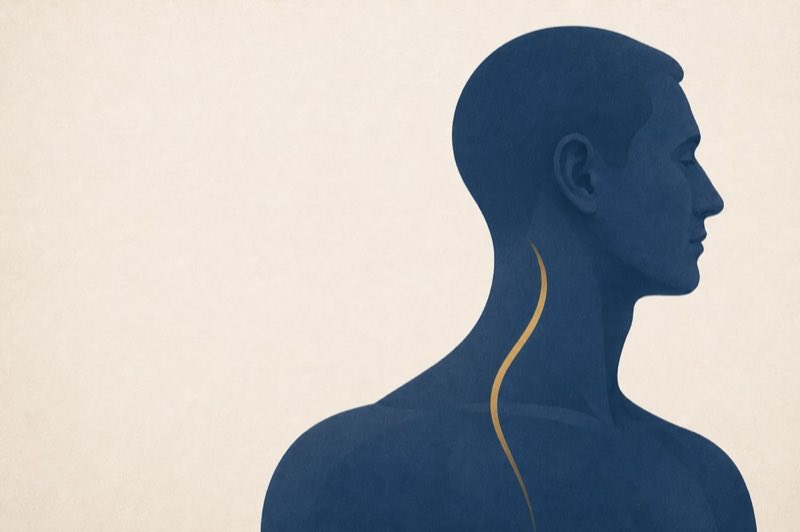
The Cervical Spine consists of 7 bones (vertebrae) stacked on top of one another with a natural ‘S’ shaped curvature. This curvature helps alleviate compression and strain forces that inevitably get put through our neck and shoulders every day. Functionally, when it comes to how the neck moves, there are 3 distinct “zones” from which different movements occur.
1) Upper Cervical Spine (C0- C2): The most complex and important vertebrae and joints of the neck. The main movements here are flexion/extension (nodding) and rotation (about 45 degrees each way). Obviously, if you are having pain turning your head to either direction, significant focus should be placed on getting these joints to move and function. This is usually where treatment would start.
2) Middle Cervical Spine (C2- C6): These are the largest and most moveable vertebrae and joints in the body. Each segment has roughly 5 degrees of movement in all directions.
3) Lower Cervical/Upper Thoracic Spine: Junction from neck and upper back. This area has distinct movement properties and if restricted, pain will usually be noted at the end range of movement in all directions.
Strategies for Managing Acute Neck Pain
First and foremost, the most important strategy to “put out the fire” so to speak, is to identify and address the AGGRAVATING factors that are causing the inflammation or restriction in your neck. If these are not addressed immediately, it’s like “picking a scab” and the pain tends to carry on much longer.
1) Reading:
Bring the book to your eyes, not your eyes to the book. Many of us are forced to read for work or pleasure, be it a textbook or cell phone and it’s usually for multiple hours a day. The best strategy for this is to read with your elbows supported (using pillows or arm rests on desk a chair) while keeping your neck in a neutral position.
2) Desk Work:
Most of us know the importance of “ideal posture” when doing hours of work at a desk, however, being in an anatomically ideal posture may not be the best thing for YOU. The main points that I address with patients are:
- Get as close to the desk as possible - minimizes reaching which activates shoulder girdle muscles and puts more stress and load through the neck.
- Use arm rests - decreases extra muscle activation and load on the neck.
- Feet flat on the floor - helps promote a more upright position.
3) Sleeping:
In my experience, this is the MOST IMPORTANT thing to address immediately when the neck is acting up.
- Use a towel roll under a flat pillow. Towel rolls are great because they are easily available, adjustable to your specific position of comfort, and provide excellent support for an aching and painful neck. The idea when managing an acute neck flare-up is to have the joint rest in a NEUTRAL spinal position. Facet joints in the spine respond best to being in a neutral and unstressed position when healing. This is no different than putting a brace on an acute ankle sprain.
4) Upper Extremity Activity/Exercises:
The main exercises to avoid would be any shrugging or overhead pressing (including bench). Activation of the upper trapezius and levator scapulae muscles puts excess load on the neck. Alternatives would be to focus on “pulling” muscles while the area is calming down.
While this is a brief overview, it gives some of the major areas to focus on when your neck flares up. Working with a skilled professional can help to further identify triggers and aggravating factors that could potentially prolong the recovery.
Finally, as performance physical therapists, our goal is to prevent this from happening in the first place. Stay tuned for future editions for more helpful strategies to keep you performing your best in life, work, and sport.
Client Spotlight: Steve

Steve was referred to me a little over a year ago for treatment of groin pain. He was in his early 60’s and had a history of cardiac issues, high cholesterol, and chronic low back pain. He was also overweight and had a high-stress job that often required him to work long hours.
Steve was an active guy. He liked to use his free time to do projects around the house and enjoyed going on trips with his family. These things were very important to him, and the pain in his groin was negatively affecting his ability to do these activities.
After his evaluation, Steve and I began a twice per week treatment plan that consisted of manual therapy techniques and corrective exercises. He stuck to the plan and gradually his groin felt better and better. Soon his pain had gone away completely.
Steve also had chronic low back pain that would flare up periodically. The pain was debilitating and would often require bed rest. So, we put together another treatment plan and Steve continued twice per week.
Eventually, Steve didn’t suffer any episodes of back pain and had no recurrence of his groin pain. With these issues resolved, he was able to resume his house projects and family trips pain-free. However, we had to decrease the chance of these issues coming back in the future and preventing Steve from doing the things he loves.
To do that, Steve had to work on his fitness. He had to get stronger, improve his endurance, and lose some weight. His sessions changed accordingly, looking very different from when we first started working together. During one of his recent sessions, Steve was slightly out of breath after finishing an exercise circuit. When he left, another client turned to me and said, “That guy is a beast!” It made me laugh, but it also made me think about how far Steve had come since I met him.
A few weeks ago, Steve had his yearly physical with his doctor. He was happy to report that he lost weight, but perhaps more importantly, his body composition had changed. His body fat percentage decreased, and his percentage of lean muscle mass increased. I don’t think I’d ever seen Steve so excited. Now he wanted to talk more about nutrition so he could take his results to the next level.
Steve’s story is a common one here at PT Progression. Our individualized treatments are designed to get you out of pain and back to doing the activities you love at an even higher level. We get the results you desire in the most efficient way possible so you can resume your activities sooner.
November Special: FREE Wellness Evaluations

Steve's transformation (described above in our Client Spotlight) is something we’d like you to experience as well, which is why we’ve decided to offer FREE 30-minute Wellness Evaluations for the month of November. If pain is preventing you from living the active life you want, reply to this email to schedule your FREE evaluation today!
P.S. We only have room for 10 FREE Wellness Evaluations right now. Booking will be open through this Friday, November 3rd. Book now!