
Messi's Age Defying Secret


What Lionel Messi Can Teach Us About Staying Healthy
I’ll admit it. Going into the World Cup semifinal, I found myself torn.
My head was rooting for England. Much of my family heritage traces back there, so it is hard not to pull for the Three Lions. But my heart was rooting for Lionel Messi.
I have always admired the way Messi carries himself. I feel like we grew up together, same age and I believe same general temperment. He remains remarkably composed under pressure, lets his play do the talking, leads by example, and demonstrates a level of humility that seems increasingly rare in professional sports.
What makes his career even more impressive is that he does not look like the typical elite athlete.
At 5 feet 7 inches, Messi is not the biggest, strongest, or most physically imposing player on the field. As a child, he required growth hormone treatment to help address a growth hormone deficiency.
Yet at the age of 39, well past the prime for most professional soccer players, he continues to perform at an extraordinary level, adding to a career already considered one of the greatest in sports history.
So, what is his secret?
It is not trying to become someone else. Messi has spent his career maximizing the body he has.
That philosophy is one we believe in every day at PT Progression.
Whether you are recovering from surgery, training for your first 5K, trying to improve your golf game, or simply hoping to stay active as you get older, the goal is not to move like someone else. It is to help your body move as well as it is capable of moving. One habit that has reportedly played an important role in Messi’s longevity is mobility work.
He is known for dedicating significant time to stretching, flexibility, and recovery. While most of us do not have an hour every day to devote to mobility, the science behind stretching offers several useful lessons.
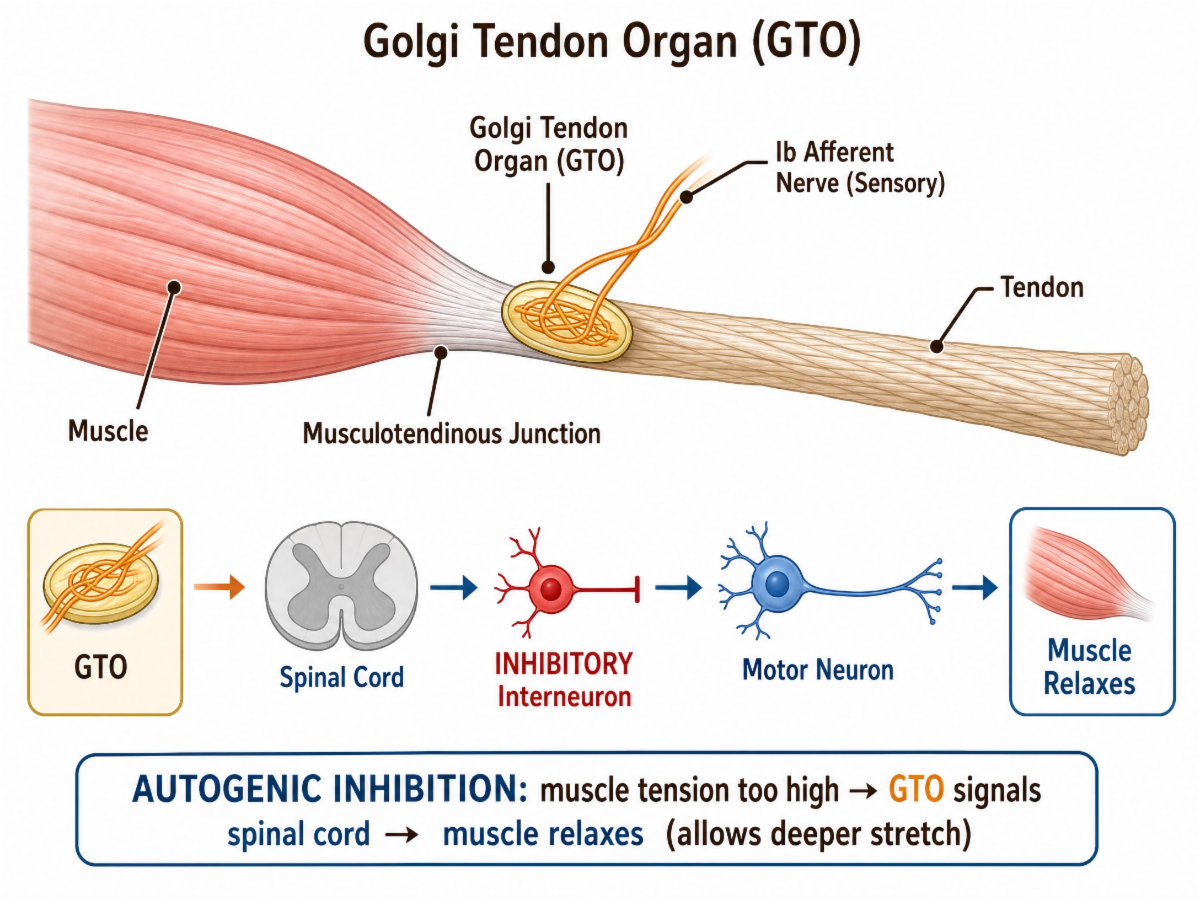
Your Nervous System Plays a Major Role in Flexibility
Most people think stretching is simply about making a muscle longer. It is a little more complicated than that.
When you stretch, you are also communicating with your nervous system. Tiny sensory receptors inside your muscles monitor changes in muscle length and tension. When a muscle is stretched too quickly or too aggressively, your nervous system may respond by tightening the muscle to protect it.
This is known as the stretch reflex.
It is one reason bouncing aggressively into a stretch is often uncomfortable and may not be the best way to improve mobility. When a stretch is performed slowly and held for a longer period, your nervous system has more time to recognize that the position is safe. The muscle can gradually relax, allowing you to move into a greater range with less resistance.
That is why holding a static stretch for a minimum of 30 seconds is often more effective than quickly moving in and out of the position. The goal is not to force the muscle into submission. It is to help the nervous system feel comfortable allowing more movement.
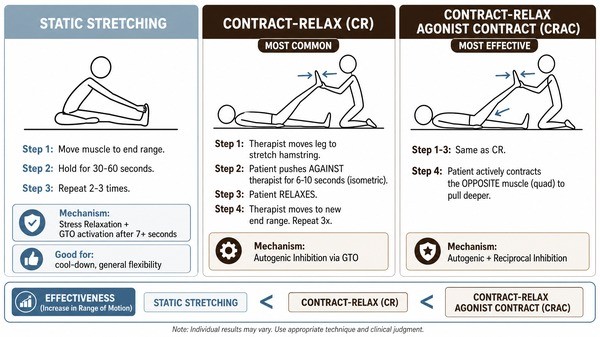
A Better Way to Improve Mobility
One technique we frequently use at PT Progression is called proprioceptive neuromuscular facilitation, better known as PNF stretching. The name sounds complicated, but the concept is fairly simple.
Instead of only holding a stretch, you briefly contract the muscle before relaxing into a deeper stretch.
For example, during a hamstring stretch, you might gently push your leg against resistance for several seconds. After the contraction, you relax and gradually move farther into the stretch. This brief contraction can help decrease the nervous system’s resistance to the movement, often allowing for greater short-term improvements in mobility than static stretching alone.
Another variation involves contracting the muscle on the opposite side of the joint. During a hamstring stretch, that might mean actively tightening the quadriceps to help the hamstrings relax. This process is known as reciprocal inhibition. When one muscle contracts, the nervous system helps reduce activity in the opposing muscle.
These techniques can be especially helpful when someone has a specific mobility restriction that is affecting how they walk, run, lift, swing a golf club, or perform daily activities.
Timing Matters
Stretching is not automatically good or bad before exercise. It depends on the type of stretching, the activity you are about to perform, and the length of time you spend doing it.
Long or aggressive static stretching immediately before sprinting, jumping, or lifting heavy weights may temporarily reduce power output.
Before athletic activity, we generally prefer a dynamic warmup that prepares the body for the movements it is about to perform.
Longer static stretching and PNF techniques are often better used after exercise or during a dedicated mobility session.
The warmup should prepare you to perform. The mobility session should help improve the positions you are able to access over time.
Consistency Beats Intensity
The biggest lesson from Messi’s approach is not that everyone needs to stretch for an hour each day.
It is that the qualities we want to maintain require consistent attention. Mobility tends to decline gradually. It is often not one injury or one bad movement that causes the problem. It is years of avoiding certain positions, sitting for long periods, recovering incompletely from previous injuries, or repeatedly moving around a restriction.
A few minutes of focused mobility work performed consistently will usually accomplish more than an aggressive hour-long stretching session once every few weeks.
Your routine does not need to be complicated.Identify the movements that are limited, choose a few exercises that address those restrictions, and perform them regularly.
More is not always better. The right exercise performed consistently is what matters.
Be the Captain of Your Recovery
Messi’s greatest advantage was not extraordinary size or physical strength.
It was his ability to understand his own strengths, remain composed under pressure, and consistently improve the qualities that mattered most to his game.
The same principle applies to rehabilitation and long term health. You do not need to train like a professional athlete. But improving your mobility, strength, balance, and movement quality can help you perform better, reduce unnecessary setbacks, and continue doing the activities you enjoy.
At PT Progression, we do not believe in cookie cutter programs. We meet you where you are, evaluate how your body moves, identify what may be holding you back, and create a plan based on your goals.
Successful rehabilitation is not about forcing your body into someone else’s mold.
It is about becoming the strongest, healthiest, and most capable version of yourself.
We Are Hiring!
PT Progression continues to grow, and we’re looking for a motivated Physical Therapist who wants to be part of something different.
Our model is simple: one-on-one care and the freedom to truly focus on helping people move and perform better. We work with active adults, athletes, and people who want to stay strong for life.
This is a great opportunity for someone who values clinical autonomy, building real relationships with patients, and being part of a positive, team-oriented environment.
If you or someone you know might be a good fit, we’d love to connect.
Reach out to Shawn to learn more: ptprogressionma@gmail.com

Learn More From Us!
- Have questions? We're happy to help! Shoot us an email at ptprogressionma@gmail.com
- Rather call? We're happy to chat over the phone at (508) 650-1984